Paris · Bakery Guides
The Chase for the Perfect Jambon-Beurre in Paris
A guide to the perfect Paris jambon-beurre, including baguette Tradition, semi-salted butter, Prince de Paris ham, and where to try it.

Jermie Borjn
May 27, 2026 · Updated May 28, 2026 · 8 min read
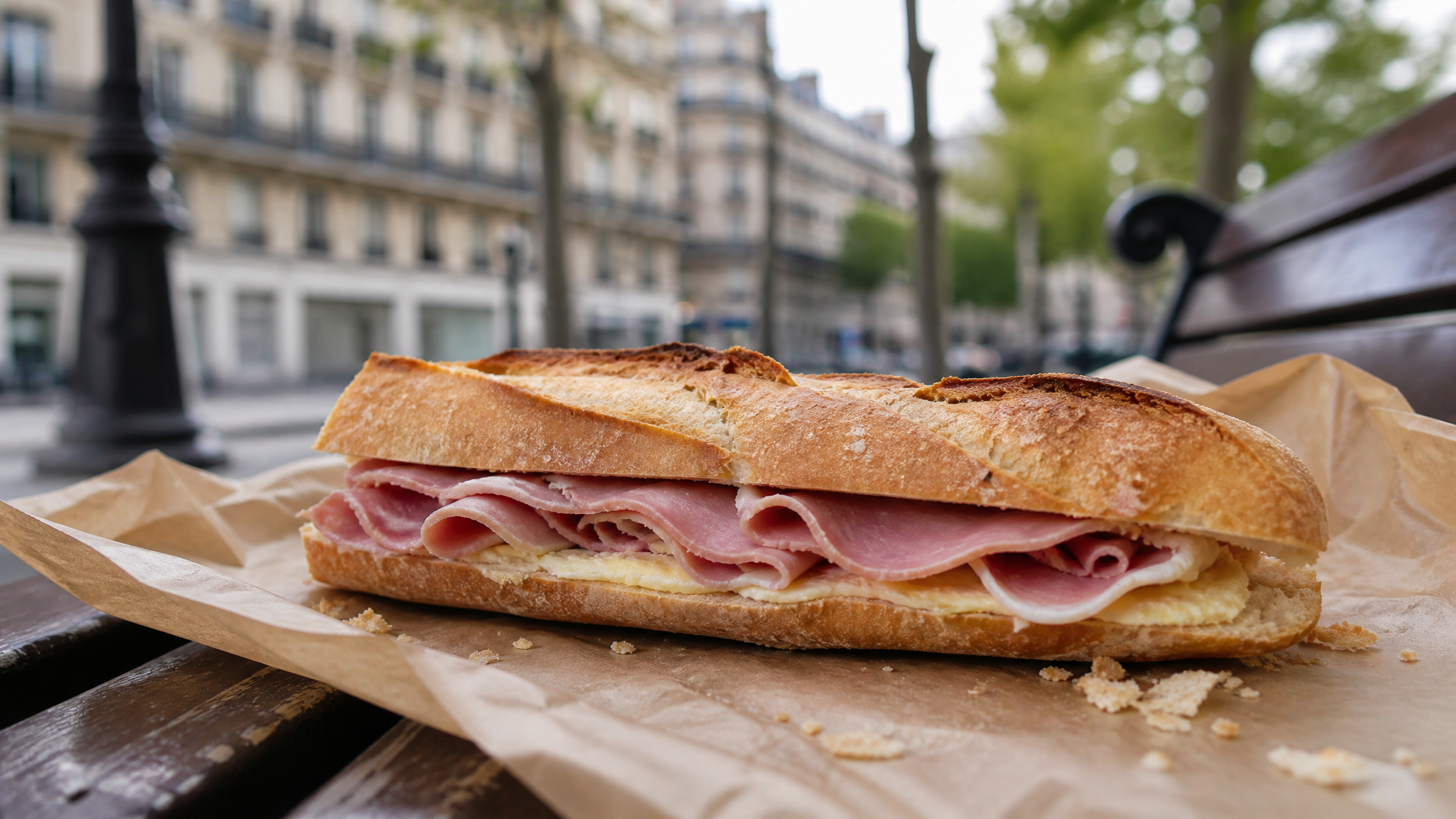
Three ingredients. Bread, butter, ham. That is all a jambon-beurre promises, which is exactly why it is so dangerous. There is nowhere to hide. A complicated sandwich can distract you with sauce, pickles, heat, crunch, herbs, or abundance. A jambon-beurre stands almost naked. If the bread is tired, you know. If the butter is cheap, you know. If the ham tastes industrial, you know before the second bite. France’s simplest sandwich is not simple because it is easy. It is simple because the standards are brutal.
In Paris, the jambon-beurre is everywhere: train stations, bakeries, office lunch counters, museum cafés, corner shops. Most are merely functional. Some are crimes against bread. A great one, however, is a small gastronomic event. It turns three ordinary words into a lesson in French restraint: no lettuce, no tomato, no mustard unless you are deliberately leaving the classic lane. Just a crisp baguette, excellent butter, and ham with enough character to justify the silence around it.
The holy trinity
Start with the baguette. The best version is usually made with baguette de tradition française, often shortened to baguette Tradition. By law and practice, this style is associated with a more traditional dough and better crust than the bland white sticks sold by indifferent bakeries. For a sandwich, the baguette must be crisp but not weaponized. It should crack lightly, give off a wheat smell, and have an interior that can hold butter without collapsing into paste.
Then comes butter. Not a thin anonymous smear, not refrigerated wax, and absolutely not margarine. The ideal is high-quality demi-sel, semi-salted butter, often from Normandy or Brittany. The salt matters. It wakes up the bread and gives the ham a frame. You should taste dairy, sweetness, salt, and cool richness. A good jambon-beurre is not greasy; it is clean and luxurious in a way that makes you wonder why anyone ever added mayonnaise to anything.
Finally, the ham. In Paris, the romantic answer is jambon de Paris, and the name to know is Prince de Paris, one of the last traditional Paris ham producers. You will not find it everywhere, and a sandwich does not have to use that exact ham to be good, but the standard it represents is useful: pale pink, gently seasoned, moist but not wet, sliced thin, and tasting like pork rather than saltwater. The ham should be generous enough to matter and restrained enough not to turn the sandwich into a deli stack.
How to spot a good boulangerie sandwich
Look at the bread first. A good bakery will have real crust color, not a pale tube. The sandwich should not look like it has spent half a day sweating inside plastic. If the baguette is wrapped too tightly and the crust has gone soft, walk away. Refrigeration is the enemy of the jambon-beurre. It hardens butter, dulls bread, and turns a crisp lunch into a cold obligation.
A serious boulangerie often makes sandwiches close to lunch service and sells through them. That turnover matters more than fancy signage. Watch what locals buy. If office workers are leaving with baguette sandwiches wrapped in paper, you are in a better place than a bakery window filled with tired triangles. Also trust smell. A bakery that smells like active baking has a head start over one that smells only like sugar and display case.
Where to start the hunt
For a polished benchmark, try the jambon-beurre at Le Petit Vendôme near Opéra, a beloved address where the sandwich has long been treated with proper respect. It is not a secret, but it is useful because it shows how satisfying the classic can be when the ingredients are chosen carefully. Eat it standing, sitting nearby, or walking toward the Tuileries if you want the full Paris lunch fantasy without pretending to be above it.
For a bakery-focused version, look at places such as Boulangerie Utopie in the 11th, where bread is taken seriously and simple things are less likely to be neglected. Another strong direction is a quality neighborhood boulangerie with a steady lunch crowd rather than a famous pastry boutique. The perfect jambon-beurre is often not the one with the most press. It is the one made at 11:45, sold by 12:30, and eaten on a bench before the crust forgets itself.
If you want a classic picnic setting, buy one near the Luxembourg Gardens, the Canal Saint-Martin, or a neighborhood square and eat it immediately. The bench is not incidental. The jambon-beurre is a public-space sandwich. It belongs to lunch breaks, train platforms, school memories, and people who understand that good butter does not need decoration.
A jambon-beurre is a lie detector for bakeries. Three ingredients tell you almost everything.
Jermie Borjn
What perfection tastes like
The first bite should be mostly texture: the crust shattering, the crumb pulling gently, the butter resisting for half a second before softening. Then salt arrives, then the sweet dairy note, then ham. Nothing should shout. The sandwich should feel balanced, almost modest, until you realize you have eaten half of it without looking up. That is the sign. Not drama, not novelty, but disappearance.
The bench test
The final test is not in the shop but on the bench. Unwrap the sandwich and wait five seconds. Does the crust still sound alive when you press it? Does the butter sit visibly against the crumb rather than disappearing into it? Does the ham fold naturally instead of lying flat like plastic? These small details matter because the jambon-beurre is built from timing. It is at its best in the short window after assembly, before refrigeration, humidity, and neglect begin to erase the bakery’s work.
This is why the sandwich is such a useful lunch for travelers. You can judge a bakery quickly, eat well without losing half a day, and still feel connected to a deeply French habit. Office workers, students, train passengers, and old men with newspapers all understand the format. The jambon-beurre is democratic, but only when the bakery respects it.
- Choose baguette Tradition when possible.
- Look for semi-salted butter from Normandy or Brittany.
- Prince de Paris ham is a traditional benchmark, but quality matters more than name-dropping.
- Avoid plastic-wrapped sandwiches with soft crusts.
- Eat immediately, ideally on a bench within ten minutes of buying.
The jambon-beurre teaches the central lesson of French eating: simplicity is not an excuse to care less. It is a demand to care more. Bread, butter, ham. When all three are right, the sandwich becomes a small edible argument for restraint. When one fails, there is nowhere for it to hide.
FAQ
Questions travelers ask
- What is a jambon-beurre?
- A jambon-beurre is a classic French sandwich made with baguette, butter, and ham.
- What bread is best for jambon-beurre?
- A crisp baguette Tradition is ideal because it has better crust, flavor, and structure than a bland standard baguette.
- Where can I try a good jambon-beurre in Paris?
- Le Petit Vendôme is a classic benchmark. Serious neighborhood boulangeries with strong lunch turnover are also good places to look.
- How do I avoid a bad jambon-beurre?
- Avoid cold plastic-wrapped sandwiches with soft crusts, hard butter, or ham that looks wet and industrial.