Paris · Immigrant Food
The Hidden Cambodian Kuy Teav Soup of Paris’s 13th Arrondissement
A guide to seeking Cambodian kuy teav soup in Paris’s 13th arrondissement, through neon signs, family restaurants, rice noodles, pork and seafood broth, and fresh herbs.

Jermie Borjn
May 27, 2026 · Updated May 28, 2026 · 8 min read
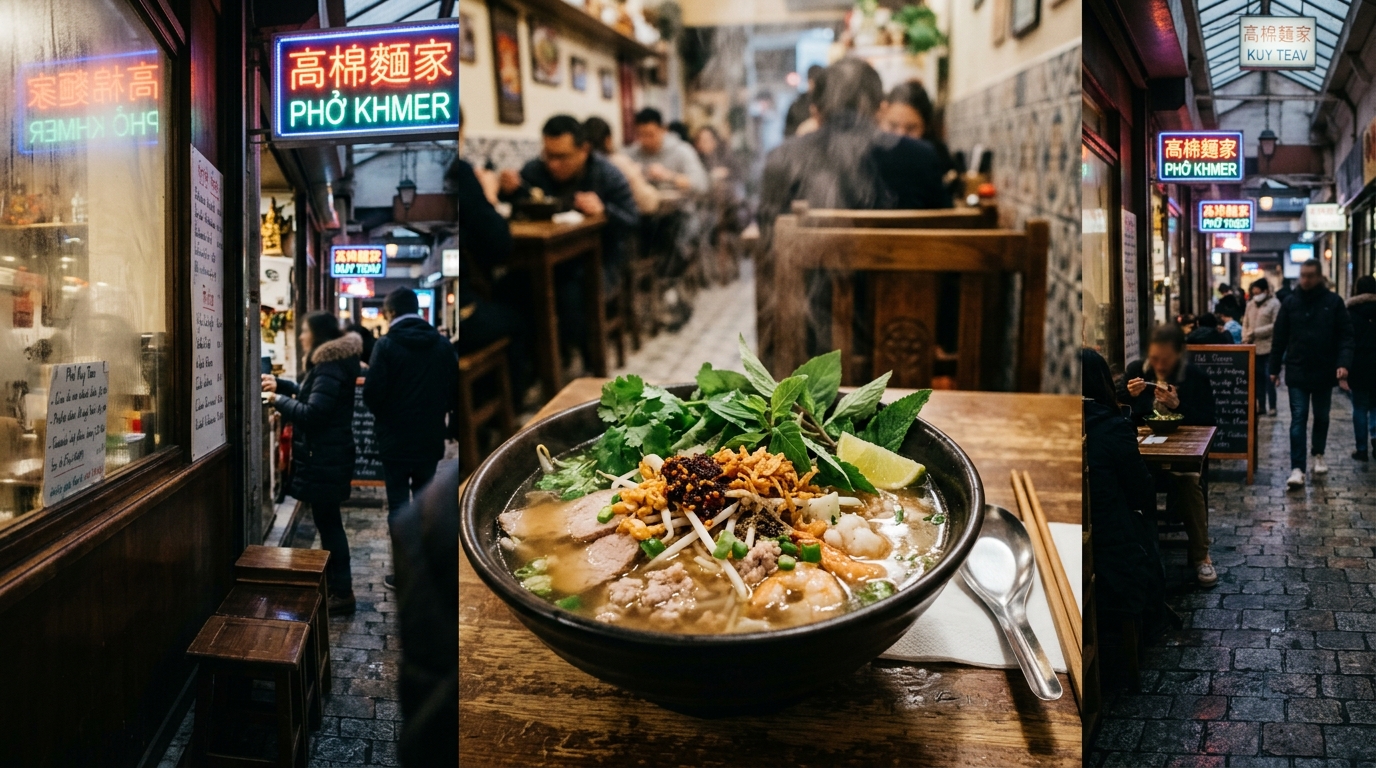
The secret to surviving a real Paris winter is not always onion soup buried under melted cheese. Sometimes it is a Cambodian noodle soup served deep inside the 13th arrondissement, in a restaurant with fluorescent lights, family service, no interest in your fantasy of Paris, and broth that warms you faster than any bistro fireplace. The bowl is called kuy teav, and if you only eat French classics while visiting Paris, you will miss one of the city’s great cold-weather comforts.
The 13th arrondissement does not look like the Paris many travelers came to see. Around Avenue de Choisy, Avenue d’Ivry, and the surrounding towers and shopping passages, the city changes scale. Neon signs replace wrought-iron romance. Supermarkets sell herbs in quantities that make small Paris grocery bundles look unserious. Roast meats hang in windows. Bubble tea shops, Vietnamese canteens, Chinese bakeries, Lao and Cambodian addresses, and family restaurants sit beside each other in a dense map of Asian Paris.
Finding the right kind of restaurant
The best places for kuy teav are rarely theatrical. Do not look for a designer dining room or a menu rewritten for people who need every dish explained as a concept. Look for small family restaurants, laminated menus, regulars, steam, and bowls moving quickly from kitchen to table. English may be limited or absent. That is not a problem. Pointing, smiling, and learning the name of the dish will get you further than insisting the neighborhood become easier for you.
Part of the pleasure is the search. Walk past the big neon signs. Step into an Asian shopping passage. Notice which restaurants are full at lunch, which tables have condiments arranged like tools, which bowls leave the kitchen with herbs piled high. The 13th rewards people who slow down and observe. It is one of the rare parts of Paris where a visitor can still feel deliciously under-informed.
What is kuy teav?
Kuy teav is a Cambodian noodle soup, often eaten for breakfast or lunch, built around rice noodles and a clear, savory broth. Versions vary by family, restaurant, and region, but the Paris bowls you may encounter often involve pork broth, sometimes seafood notes, slices or pieces of pork, shrimp or fish elements, fried garlic, scallions, and a generous finish of fresh herbs. Lime, chili, bean sprouts, and sauces may appear at the table, allowing you to tune the bowl yourself.
The beauty of kuy teav is its balance. It is lighter than a cream-based soup and brighter than many winter stews, but it still feels deeply comforting. The rice noodles slip through the broth. The pork gives body. Seafood brings sweetness or salinity depending on the version. Herbs lift the steam. Chili turns warmth into heat. Fried garlic adds the small roasted note that makes you keep reaching for another spoonful.
Why it belongs in Paris
Cambodian food in Paris is part of a wider history of migration from Southeast Asia, especially after the wars and upheavals of the twentieth century. The 13th arrondissement became one of the city’s major Asian food centers, not as a theme park but as a living neighborhood. Eating kuy teav here is not a detour from Paris. It is a way of understanding Paris more fully.
That matters because travelers often reduce French food to a narrow list: croissant, steak frites, onion soup, escargots, macarons. Those foods can be wonderful, but they are not the whole city. Paris is also Cambodian noodle soup under fluorescent lights, Vietnamese sandwiches in Belleville, North African couscous, Chinese roast duck, West African stews, and bakeries run by people whose families arrived from somewhere else and changed the city’s appetite.
The 13th arrondissement teaches the same lesson as every great food city: the most important meals are not always the most photogenic.
Jermie Borjn
The winter bowl
Order kuy teav on a cold day and pay attention to the first minute. The bowl arrives steaming. The herbs soften as they hit the broth. The noodles are tangled but gentle. The aroma is savory, garlicky, a little sweet, a little marine if seafood is involved. Add lime if it is offered. Add chili carefully, then less carefully if the day has been particularly gray. The soup changes as you eat; the herbs sink, the broth deepens, the noodles absorb flavor.
Unlike onion soup, which often feels like a blanket, kuy teav feels like a window opening. It warms without weighing you down. You leave full but not defeated, with garlic on your breath and the strange happiness of having eaten something both unfamiliar and instantly sensible. That is a rare food-travel feeling, and it is worth crossing town for.
How to explore respectfully
Go at lunch, when turnover is higher and the room has energy. Do not treat the neighborhood as a secret prop. These are working restaurants serving communities, not hidden stages for adventurous visitors. If there is no English menu, be patient. If the staff is busy, be concise. Learn the dish name. Bring a little flexibility, because the best bowl may not match the exact version you imagined.
How to season the bowl
When the bowl arrives, taste the broth before adding anything. This is the polite move and the smarter one. Some versions are delicate and pork-forward; others carry more seafood sweetness or garlic. After that first spoonful, adjust slowly. A squeeze of lime sharpens the broth. Chili adds heat but can flatten nuance if you dump it in too quickly. Fresh herbs should be pushed into the steam so they soften without disappearing. The best bowl changes every few minutes as the noodles, broth, and condiments settle into each other.
If you are traveling with someone who only wants “classic Paris,” this is the meal that may change their mind. The room will not look romantic in the usual way, but romance is not always candlelight and brass rails. Sometimes it is a family restaurant on a wet day, a bowl too hot to rush, and the realization that Paris has been much larger than your checklist all along.
- Start around Avenue de Choisy or Avenue d’Ivry.
- Look for family restaurants with busy lunch service.
- Do not worry if there is no English menu; learn the name kuy teav.
- Season gradually with lime, chili, herbs, and sauces if offered.
- Visit in winter or on a rainy day for maximum comfort.
The best Paris meals are not always framed by monuments. Some are found under neon, inside passages, above plastic tablecloths, in bowls carried by someone who has served the same soup a thousand times. Kuy teav in the 13th is one of those meals. It will not replace onion soup. It will simply make your Paris larger.
FAQ
Questions travelers ask
- What is kuy teav?
- Kuy teav is a Cambodian rice-noodle soup often made with pork broth, herbs, fried garlic, and sometimes seafood or pork toppings.
- Where can I find Cambodian food in Paris?
- The 13th arrondissement, especially around Avenue de Choisy and Avenue d’Ivry, is one of the best areas to look for Cambodian and broader Southeast Asian food.
- Is the 13th arrondissement worth visiting for food?
- Yes. It offers one of the richest Asian food landscapes in Paris, from family restaurants and supermarkets to bakeries and noodle shops.
- Is kuy teav good in winter?
- Yes. Its hot broth, rice noodles, herbs, garlic, and chili make it one of the most comforting cold-weather meals in Paris.